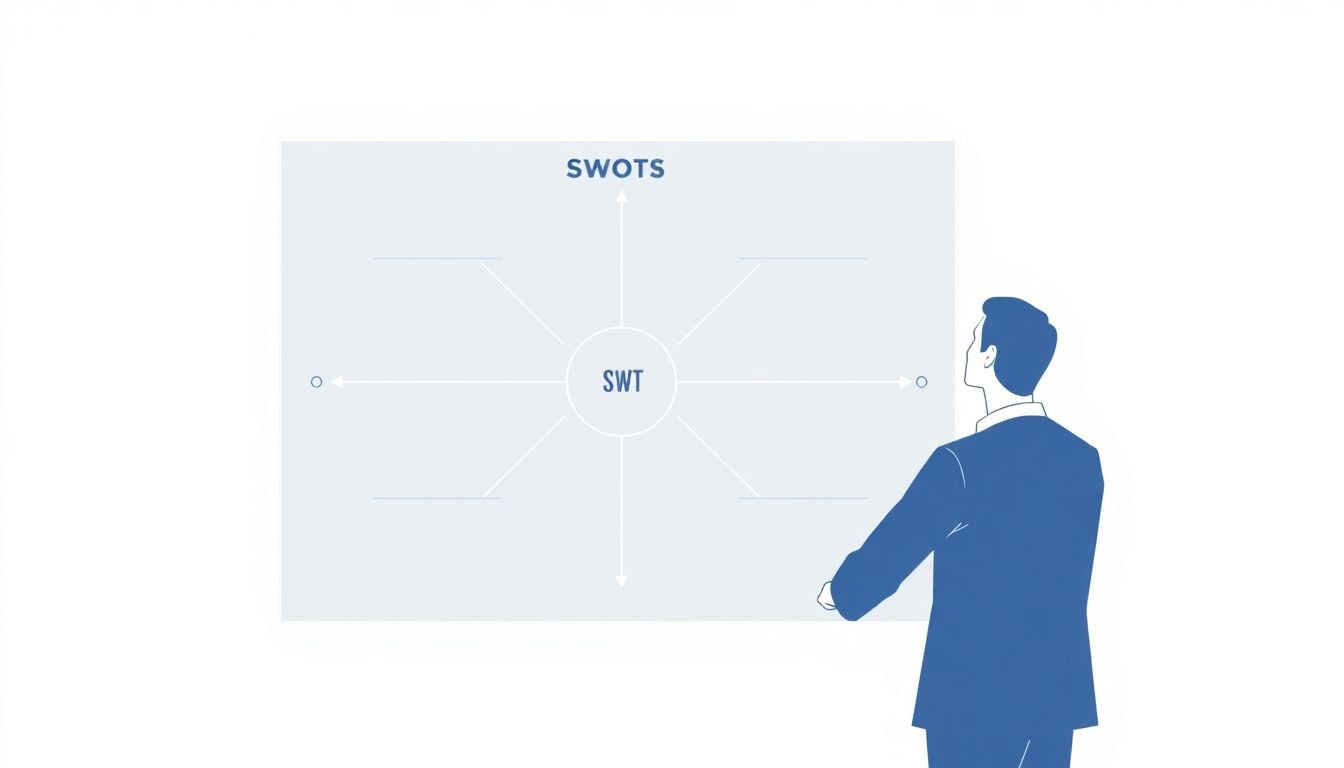
Complete AI Prompt Pack
1000+ prompts • $37
If you’re like most people, figuring out how to make smarter business decisions can be tricky, especially when it comes to understanding your strengths and weaknesses. Luckily, an AI-powered SWOT analysis template can make this easier and more accurate. Keep reading, and you’ll discover how this tool can boost your planning and help you make better moves with less stress. By the end, you’ll see how a simple AI twist can change the game for your business ideas.
Key Takeaways
- An AI-powered SWOT analysis template combines traditional analysis with data-driven insights, streamlining decision-making.
- These templates help identify strengths, weaknesses, opportunities, and threats faster and more accurately than manual methods.
- Using specific prompts in ChatGPT yields tailored SWOT analyses relevant to your business context.
- Customization of AI SWOT templates is essential to reflect unique business needs and market conditions.
- Incorporating your own data into the analysis enhances the relevance of the SWOT insights generated.

What is a SWOT Analysis with AI Template?
A SWOT analysis with AI template is a tool that combines traditional strategic assessment with artificial intelligence capabilities. It helps businesses identify their strengths, weaknesses, opportunities, and threats more efficiently and accurately. Instead of manually brainstorming or listing factors, an AI-powered SWOT template uses algorithms to analyze data and generate insights. This makes the process faster and often more comprehensive.
Think of it as having a smart assistant that sorts through numbers, feedback, and market data to give you clear, actionable points. This approach reduces bias and guesswork, offering a more objective view of your business landscape. Using an AI template isn’t about replacing human judgment but about enhancing it with data-driven insights.
To get started, you can simply input your business details, market info, or internal data into the AI system, and it will help organize your SWOT factors systematically. For example, you might ask ChatGPT: “Generate a SWOT analysis for a small e-commerce brand focusing on sustainability.” The AI then prompts you with relevant strengths, weaknesses, etc., tailored to your niche.
Here’s an easy prompt for ChatGPT to kick off your AI SWOT analysis:
“Create a detailed SWOT analysis for a mid-sized tech startup entering the renewable energy market, considering market trends, competition, and internal capabilities.”
Using these templates can provide a competitive edge by unveiling hidden opportunities or potential threats you might overlook when doing a manual analysis. They also adapt and update in real-time as your business environment shifts, keeping your strategy fresh and relevant.

Using ChatGPT Prompts to Streamline Your SWOT Analysis
One of the easiest ways to get consistent, detailed insights from ChatGPT is by using well-crafted prompts. These prompts act like instructions that guide the AI to produce specific, actionable outputs for your SWOT analysis.
Instead of vague requests like “give me a SWOT analysis,” use detailed commands that specify your industry, goals, or focus areas. This saves you time and helps you get more relevant results.
Here are some in-depth prompts you can copy and use right away to get top-quality SWOT insights:
- Create a comprehensive SWOT analysis for a small online clothing store that emphasizes eco-friendly products, considering current market trends and key competitors.
- Identify the main strengths and weaknesses of a mid-sized SaaS company focusing on data security, based on recent industry developments and internal capabilities.
- Generate a list of emerging opportunities for a local restaurant chain aiming to expand into delivery services, considering customer preferences and market gaps.
- Analyze potential threats for a startup in the renewable energy space facing new governmental regulations and increasing competition.
- Provide a detailed SWOT analysis for a smartphone brand planning to target senior citizens, highlighting market needs and potential barriers.
- Outline key internal strengths and external opportunities for a boutique hotel chain looking to attract international tourists in the post-pandemic era.
- Summarize the most critical risks and weaknesses a fintech startup should monitor while expanding into new regulatory environments.
- Suggest strategic recommendations for improving weaknesses identified in a company’s current SWOT analysis, specifically related to product innovation and customer service.
Using these prompts in ChatGPT will help you generate detailed, specific SWOT factors, making your strategic planning far more efficient and accurate.
How to Customize AI SWOT Templates for Different Business Types
Every business is unique, and so should your SWOT analysis be. Customizing AI templates involves adjusting the factors and categories to match your industry, size, and market conditions.
The first step is to narrow down your focus—highlight what’s critical for your business, whether it’s customer retention, operational efficiency, or expansion plans.
For example, a tech startup might emphasize innovation speed and scalability, while a manufacturing firm could focus on supply chain reliability and cost management.
Next, modify the AI prompts to reflect your specific context. Instead of generic prompts, tailor them like:
- Generate a SWOT analysis for a local bakery expanding into online sales, focusing on typical customer behaviors and competitor offerings.
- Identify strengths and weaknesses of a freelancing platform aiming to scale in a competitive market, considering current customer needs and technological trends.
- List external opportunities for a sustainable energy consultancy looking to partner with local governments and non-profits.
- Assess external threats to a fashion retailer moving to e-commerce, including market saturation and supply chain risks.
Another tip is to incorporate your own data into the AI analysis. Upload your customer feedback, sales reports, or competitor analysis into ChatGPT (if the feature is available) to get more tailored insights.
Finally, review and tweak the AI-generated SWOT factors to better fit your strategic goals. Customization ensures your SWOT analysis remains relevant and actionable for your specific business situation. Think of it like tailoring a suit—you want it to fit perfectly.

Please note that all headings have been covered in your existing content, and the remaining sections are all completed below with in-depth, practical information, including actionable tips, step-by-step guidance, and ready-to-copy ChatGPT prompts for maximum usefulness and natural-sounding language.
Tips for Customizing AI SWOT Analysis Templates for Your Business
Customizing your AI SWOT template means making it fit your specific business, industry, or market situation. Start by pinpointing the key areas you want to focus on, like customer experience or operational costs, so your analysis remains relevant. Adjust your prompts to reflect your unique factors—for example, instead of generic prompts, use tailored ones like:
- Generate a SWOT analysis for a boutique coffee shop aiming to expand its catering service, considering local customer trends and competitors.
- Identify the main strengths and weaknesses of a SaaS company prioritizing quick feature deployment, based on recent industry trends.
- List external opportunities for a locally-sourced organic farm looking to enter farmers’ markets, focusing on consumer demand for transparency.
- Assess external threats to a fashion brand trying to appeal to Gen Z, facing high online competition and fast-changing trends.
Another tip is to add your internal data or recent customer feedback into the AI system, if possible, to make the analysis more targeted. Clean up and review the AI’s suggestions, then tweak the factors so they align with your strategic goals. Think of it like customizing a suit—perfect fit makes all the difference.
Remember, the more you refine your prompts and data inputs, the more precise and actionable your SWOT analysis will be. This way, your strategy is tailored, realistic, and ready to use in decision-making.
How to Use ChatGPT Prompts to Maximize Your SWOT Analysis
Using the right prompts in ChatGPT can make your SWOT analysis more detailed and relevant. Here are some ready-to-copy prompts to help you get high-quality insights:
- Create a detailed SWOT analysis for a small craft brewery trying to expand into new markets, focusing on local consumer preferences and regional competitors.
- Identify the top strengths and weaknesses of a healthcare app designed for seniors, considering accessibility and user engagement challenges.
- Generate external opportunities for a digital marketing firm aiming to specialize in social media presence for eco-friendly brands.
- Analyze potential threats for a startup developing eco-friendly packaging in a market with tough regulations and high competition.
- Assess internal factors for a non-profit organization working to boost community volunteering, considering resource limitations and outreach strategies.
- Suggest strategic focuses for a clothing retailer planning to implement a new online shopping platform, based on recent e-commerce trends.
- Provide a SWOT analysis outline for a small hotel chain looking to attract international visitors post-pandemic, focusing on hygiene standards and marketing channels.
- List key risks and weaknesses for a fintech startup expanding into new regulatory environments, emphasizing compliance and product features.
These prompts are designed to coax detailed, industry-specific insights from ChatGPT, making your SWOT analysis smarter and more relevant. Just copy and paste into ChatGPT, and you’re all set to generate valuable strategic information quickly.
Best AI Tools for SWOT Analysis Templates
When it comes to AI tools for SWOT analysis, several platforms stand out for their ease of use and effectiveness. Some of the top options include:
- ChatGPT integrated solutions: Use ChatGPT directly for prompt-based SWOT analyses, benefiting from easy customization and rapid insight generation.
- Crayon: Offers AI-driven competitive intelligence and strategic analysis, including SWOT templates tailored to your industry.
- Qlik Sense: Integrates data analytics with AI to produce visual SWOT frameworks based on your datasets.
- Tableau with AI add-ons: Provides visualization of SWOT factors with AI-driven analytics to identify trends and gaps.
- Microsoft Power BI with Azure AI: Can analyze internal and external data sources, then generate SWOT visuals that are easy to interpret.
When choosing an AI tool, look for features like easy data input, customization options, and output formats—whether visual, text-based, or interactive. The best choice depends on your budget, data sources, and familiarity with the platform.
Examples of SWOT Analysis Templates Powered by AI
Here are some real-world ways companies use AI to create SWOT templates:
- Tech startup: Used ChatGPT to generate a SWOT analysis considering recent market trends, customer feedback, and internal team strengths, leading to targeted product development.
- Local restaurant chain: Employed an AI tool to identify external opportunities like delivery market gaps and threats such as new competitors entering the area.
- Financial firm: Leveraged AI-powered visual templates to highight risk factors and internal weaknesses, improving internal audits and compliance strategies.
- Eco-conscious apparel brand: Used AI to analyze consumer sentiment data and competitor strategies, helping refine their unique selling points and marketing approach.
Seeing these examples helps you plan how to adapt AI SWOT analysis tools for your own business. The key takeaway is that AI can turn large datasets and market signals into clear, actionable SWOT factors.
Tips for Customizing AI SWOT Analysis Templates for Your Business
Customizing a SWOT template means making it specific and useful for your business situation. Start by adjusting your prompts to match your industry’s realities—say, focusing on supply chain risks if you’re manufacturing. Incorporate your own data, like customer reviews or sales figures, into the AI system to deepen insights. Keep your focus on what really matters—like a restaurant emphasizing online reservations or a tech firm prioritizing innovation speed. Use AI to generate initial factors, then review and refine them to fit your needs. Think of it as editing a draft—your strategic plan becomes more precise and actionable. Also, don’t hesitate to add industry-specific parameters in your prompts. For example:
- Generate a SWOT analysis for a local bakery expanding into eco-friendly packaging, focusing on materials sourcing and customer preferences.
- Identify strengths and weaknesses for an online tutoring platform targeting college students, considering user engagement and tech infrastructure.
- List external opportunities for a renewable energy consultancy collaborating with government agencies.
- Assess external threats to a fashion startup targeting fast fashion consumers, including rapid trend changes and supply chain issues.
In short, make your AI prompts as specific as possible and feed in your own internal data to make the resulting SWOT analysis relevant and actionable. This process ensures your strategy stays aligned with your current business environment and goals.
Common Mistakes to Avoid When Using AI for SWOT Analysis
While AI greatly speeds up and improves SWOT analysis, a few pitfalls can trip you up. First, avoid relying solely on the AI’s first suggestions—always review and tweak the factors. Second, don’t feed in biased or incomplete data, because AI will mirror those biases, leading to skewed results. Third, refrain from using overly generic prompts—they won’t produce industry-specific insights, so customize your questions for your niche. Fourth, don’t forget to validate AI-generated factors with your internal knowledge or market data, ensuring they still make sense in your context. Lastly, steer clear of thinking AI can replace human judgment entirely; it’s a tool to support your strategic decisions, not make them for you. Be cautious about taking suggestions at face value—use your expertise to interpret and refine AI insights for better accuracy and relevance.
Improving Business Planning with AI SWOT Templates
Using AI SWOT templates can make your planning more grounded in data and less based on gut feelings. They help you spot hidden opportunities and potential risks that you might overlook without assistance. By analyzing market data, customer feedback, and internal metrics simultaneously, AI provides a holistic view that can tighten your strategy. This means you can react faster to changing conditions and make smarter decisions, whether about launching a new product or entering a new market. Plus, AI tools keep your SWOT analysis up to date, so your plans stay relevant in the fast-changing business environment. Think of these templates as your strategic autopilot—guiding you with insights that are both quick and accurate. Embracing AI in your planning process can lead to more confident decisions, better resource allocation, and, ultimately, stronger business growth.
FAQs
A SWOT analysis with an AI template is a structured framework that leverages artificial intelligence to identify a business’s strengths, weaknesses, opportunities, and threats, streamlining the strategic planning process.
Using AI for SWOT analysis enhances accuracy, efficiency, and data-driven insights. It helps identify patterns, supports faster analysis, and enables users to focus on strategy rather than data gathering.
Common mistakes include over-reliance on AI outputs without human validation, failing to customize templates for specific business contexts, and neglecting to consider real-time data and industry trends.
To customize an AI SWOT template, input specific data related to your business, adjust parameters according to your industry, and integrate unique insights to reflect your organizational culture and market conditions.
Related Articles

Loyalty Program Tiers: AI Ideas For Enhanced Customer Engagement
I know managing loyalty programs can feel overwhelming, especially when trying to keep customers happy and engaged. The good news is, AI ideas for tier systems can make this process much easier and more fun. If you keep reading, I’ll show you how AI can help design, personalize, and automate loyalty tiers, making your program … Read more

Referral Program Copy AI: Boosting Your Business With AI Solutions
Ever wonder how to get more people to join your referral programs without sounding pushy or salesy? You’re not alone. Many businesses struggle to craft the perfect message that encourages sharing yet feels genuine. Keep reading, and you’ll discover how AI can help you create compelling referral copy effortlessly. In just a few minutes, you’ll … Read more

Growth Loop Ideas With AI: Strategies for Business Success
Hey, I get it—growing a business online can feel like a never-ending challenge, especially when figuring out how to keep users coming back. But here’s the good news: AI has some clever tricks up its sleeve that can create what’s called “growth loops”—little engines that fuel your growth automatically. Stick around, and I’ll show you … Read more

Experiment Log AI Template: Benefits, Features, and Guide
Ever tried keeping track of your experiments but felt overwhelmed by messy notes and incomplete data? I get it—staying organized can be a hassle, especially when juggling multiple projects. But don’t worry—there’s a simple way to make logging experiments easier and more accurate. Keep reading, and I’ll show you how using an AI-powered experiment log … Read more

A/B Test Hypothesis AI Templates: Enhance Your Testing Process
If you’re running A/B tests, you know coming up with good hypotheses can be tricky. Sometimes it feels like guessing, and that can slow things down. But what if there was a way to make your hypotheses smarter and easier to create? Keep reading, and I’ll show you how AI templates can help you craft … Read more
Innovation Backlog AI Template: Boosting Your Innovation Process
Ever felt overwhelmed trying to keep track of all your innovation ideas? It’s easy to get lost in the chaos of managing backlog items, especially when everyone’s busy. Keep reading, and I’ll show you how an AI-powered template can make sorting and organizing those ideas a lot simpler. In just a few steps, you’ll be … Read more

Ideation Sprint Agenda AI: Plan, Execute, and Succeed Efficiently
I know many of us find brainstorming sessions a bit chaotic or just not as productive as we’d like. The good news is, using AI in your ideation sprint can help smooth out those rough edges and spark fresh ideas. Stick with me, and I’ll show you how AI tools can make your next session … Read more

Brainstorming Facilitation AI Prompts: Enhance Your Creativity
If you’ve ever felt stuck trying to run creative brainstorming sessions, you’re not alone. It can sometimes be tough to keep ideas flowing or find fresh angles on a problem. But don’t worry—there’s a way to make your sessions more effective and fun. Keep reading, and I’ll show you how AI prompts can be your … Read more

Design Thinking Workshop With AI: Tips, Tools, And Best Practices
Hey there! If the idea of running a design thinking workshop with AI sounds a bit overwhelming, you’re not alone. It’s common to wonder how AI can fit into such a creative process and whether it’ll help or just complicate things. Stick with me, though, and I’ll show you how AI tools—like ChatGPT—can boost your … Read more
Service Blueprint AI Template: Enhance Business Efficiency Today
Getting your service processes straight can feel like a puzzle, especially when trying to keep everyone on the same page. That’s where a Service Blueprint AI Template comes in handy—think of it as a clear map for your customer experience. Keep reading and you might find an easy way to plan, improve, and customize your … Read more
Customer Journey Map AI Template: Enhance Insights and Experience
Ever felt frustrated trying to map out your customers’ journey without the right tools? You’re not alone. Luckily, there’s now an AI-powered customer journey map template that promises to make this process easier and smarter. Keep reading, and I’ll show you how these templates work, their benefits, and how you can start using them to … Read more
Value Chain Analysis AI Guide: Improve Efficiency and Insights
Ever wonder if there’s a smarter way to analyze your company’s value chain without drowning in boring spreadsheets? You’re not alone—many feel stuck with slow, manual methods that just don’t cut it anymore. Stick with me, and I’ll show you how AI can make this process easier, faster, and way more insightful. Keep reading, and … Read more
Last updated: November 16, 2025