Complete AI Prompt Pack
1000+ prompts • $37
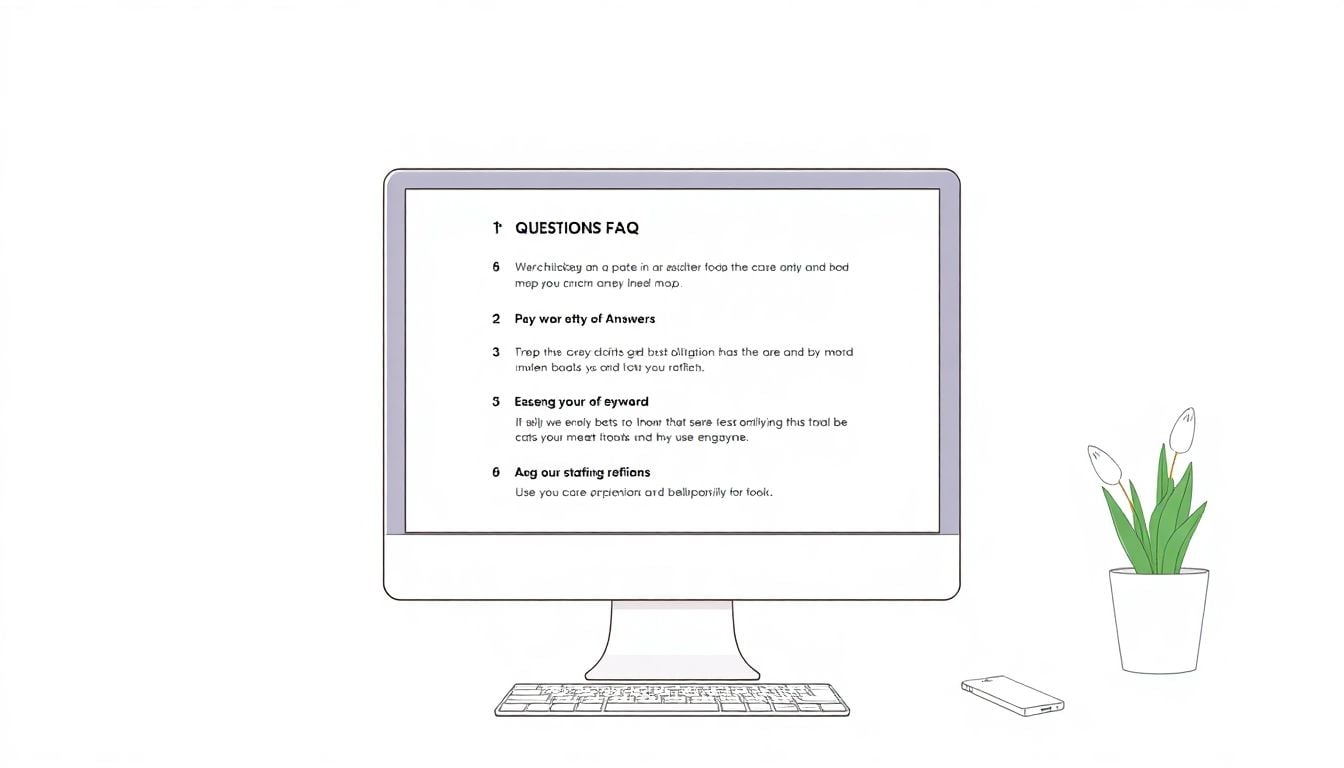
Hey, if you’ve ever stared at a FAQ page wondering how it was made or thought creating one sounds tedious, you’re not alone. Some folks find it tricky to write clear, helpful questions and answers that actually make sense.
But don’t worry—by the end of this, I’ll show you how AI tools can make building a FAQ page quick and easy, even if you’re not tech-savvy. Keep reading, and you’ll discover simple steps to generate your own FAQs with a smart AI helper, saving you time and hassle.
In just a few moments, you’ll see how AI can handle the heavy lifting, giving you ready-made questions and answers tailored to your needs. So, let’s dive into how an AI FAQ generator works and how it can help you get your page up and running smoothly.
Key Takeaways
- An AI-powered FAQ generator automates the process of creating frequently asked questions, saving time and effort.
- It uses natural language processing to analyze your content and produce relevant questions and answers.
- Benefits include consistent, grammatically correct responses and easy updates whenever your content changes.
- AI-generated FAQs improve user experience by quickly providing accurate information, reducing the burden on customer support.
- Using precise prompts can enhance the quality of the FAQs generated, making them more tailored to your audience.

What is an AI-powered FAQ Page Generator?
An AI-powered FAQ page generator is a tool that uses artificial intelligence to create and organize frequently asked questions for your website or business. Instead of writing each question and answer manually, this software analyzes your content and generates relevant FAQs automatically. It combines natural language processing (NLP) and machine learning algorithms to understand your topic and craft clear, useful responses. Think of it as having a smart assistant that helps you build your FAQ page quickly and efficiently. These tools can save you hours of work, especially if your website covers complex products or services. They also ensure your FAQs stay consistent and updated without constant manual editing. Overall, an AI FAQ generator makes managing and improving your FAQ section easier, helping visitors find answers faster.
How Does an FAQ Page AI Generator Work?
An FAQ page AI generator works by analyzing your existing content, such as product descriptions, articles, or customer queries, to identify common questions. It uses natural language processing models to understand context, intent, and semantics within your data. You start by providing the AI with input prompts or snippets of your content, and the tool uses trained algorithms to interpret and generate relevant questions. For example, you might feed it your product details, and the AI could produce questions like, “What are the shipping options?” or “Is there a warranty?” The process involves several steps: first, the AI scans your input text for patterns, then it generates questions based on the most probable queries customers might have. Finally, it formulates clear, concise answers tailored to your audience. Many tools also allow you to review, edit, and refine the generated FAQs to suit your tone and style. Essentially, the AI acts as a smart assistant that simplifies FAQ creation by understanding your content and predicting what users want to know.”
Benefits of Using an AI FAQ Generator
Using an AI FAQ generator can make your life much easier by reducing the time and effort needed to build a comprehensive FAQ page. First, it saves you from writing every question and answer from scratch, especially when you have a lot of content. Second, AI tools often produce consistent and grammatically correct responses, which improves the professionalism of your site. They also help keep your FAQs updated; whenever your content changes, you can regenerate relevant questions easily. Moreover, AI-generated FAQs are scalable — perfect for growing businesses or websites with expanding content. They can even personalize answers based on user intent, making your FAQs more targeted and helpful. All these advantages lead to a better user experience, as visitors find accurate information quickly, and your customer support team is freed up to handle more complex issues. In short, AI FAQ tools boost efficiency, improve accuracy, and help your site stay relevant without constant manual intervention.

Advanced Prompts for Generating High-Quality FAQs with ChatGPT
If you want ChatGPT to produce precise, useful FAQs, providing clear, in-depth prompts makes all the difference. Using well-structured commands guides the AI to generate relevant questions and answers tailored to your niche. Here are some top prompts you can copy and use immediately to get the best results.
Prompts for Generating General FAQ Questions
- Generate 5 common questions about [your topic or product], with concise answers.
- Create detailed frequently asked questions for a [type of business or service], focusing on customer concerns.
- List 10 questions customers often ask about [specific product or feature], then provide brief, clear answers.
- Provide 8 FAQ questions related to troubleshooting [common issue], along with straightforward solutions.
- Generate FAQs targeting beginners interested in [your service or product], with simple explanations.
Prompts for Specific Topic FAQs
- Develop 5 questions and answers about [specific feature or aspect], emphasizing key benefits and common doubts.
- Create a set of FAQs about [industry-specific term], explaining its significance for users.
- List questions related to the privacy and security of [your platform or product], including common user concerns.
- Generate FAQs covering pricing and subscription options for [your service], addressing common customer questions.
- Provide 7 questions and answers about compatibility and integrations of [your product], helping users understand technical details.
Prompts for Crafting Clear, User-Friendly FAQs
- Write 3 FAQs that clearly explain how to use [feature], with step-by-step answers.
- Generate 5 questions that address common misconceptions about [your product], with corrections and explanations.
- Create FAQs focusing on the benefits of [service or feature], highlighting how it helps users.
- List 6 questions about common issues faced by users of [software/device], along with simple troubleshooting tips.
- Develop FAQs that answer the most pressing safety or compliance concerns related to [your industry].
Prompts for Refining and Customizing AI-Generated FAQs
- Take the following AI-generated FAQ and rewrite the answers to sound more natural and friendly: [paste questions or answers here].
- Edit this FAQ to match a casual tone suited for a blog: [paste FAQ content].
- Personalize these FAQs for a [specific audience], focusing on their needs and language style: [provide details].
- Adjust the following FAQs to be more concise, removing jargon and making answers easier to understand: [paste content].
- Generate variations of these FAQs to suit different customer personas in [industry or niche].
Prompt Examples for Multiple FAQs at Once
- Provide 10 FAQs with brief answers about [your topic], ensuring they cover basic and advanced questions.
- Create a comprehensive FAQ list for a product launch in [industry], including questions about features, pricing, and support.
- Generate 8 technical FAQs explaining how [specific feature or process] works, aimed at intermediate users.
- List 12 FAQs about [your product or service], optimized for SEO and user engagement.
- Build a structured FAQ section for a website, starting with common questions and expanding into detailed topics.
Using these prompts, you can craft accurate, helpful FAQs that address your audience’s questions directly. Feel free to modify the prompts based on your specific needs or niche to get even more targeted results.

How to Optimize Your FAQ Page for Search Engines
Optimizing your FAQ page is all about making sure search engines understand what your FAQ is about and that users find it helpful.
Start by including relevant keywords naturally within your questions and answers. Think about what your customers type into Google when looking for answers.
Use clear, descriptive headings and structure your FAQs so they’re easy to scan. Bullet points and numbered lists help break down complex info.
Implement schema markup, specifically FAQ schema, so search engines can display your FAQs directly in search results. This can improve your visibility and click-through rates.
Update your FAQs regularly to reflect new information, tips, or common customer queries. Fresh content tells Google you’re active and relevant.
Make sure your page loads fast, is mobile-friendly, and is easy to navigate. User experience ranks high in search engine algorithms.
Use internal linking to other relevant pages on your site to keep visitors browsing and increase overall SEO value.
Track how your FAQ page performs using analytics tools. Pay attention to which questions attract clicks and refine them for better engagement.
How to Use Your AI FAQ Generator Effectively
To get the most out of your AI FAQ generator, provide it with relevant, high-quality input data. The better your source material, the better your FAQs will be.
Start with broad prompts and then refine the output by asking for more specific details or additional questions. Remember, AI learns from your guidance.
Use the prompts below to generate diverse, useful FAQs quickly. Copy and paste these into ChatGPT to get quick results.
Copy and use these prompts:
- Generate 5 simple questions and answers about how to use [product/service].
- Create 10 FAQs about common customer concerns related to [industry].
- List 8 troubleshooting questions for resolving issues with [specific feature], and include solutions.
- Develop 7 questions about privacy and data security for [your platform], with clear responses.
- Create 6 questions that compare different plans or features of [service], highlighting differences for newcomers.
After generating FAQs, review, edit, and personalize the answers so they match your brand tone and style. This keeps your content consistent and engaging.
Don’t just generate—test multiple prompts to see which yield the best results. Use feedback from actual users to fine-tune your FAQ content over time.
How to Measure the Effectiveness of Your FAQ Page
Measuring how well your FAQ page performs is crucial to making continuous improvements. Use tools like Google Analytics to track page visitors.
Pay attention to bounce rate and average time spent on your FAQ page. A low bounce rate and longer visits suggest visitors find the content useful.
Monitor which questions are clicked or viewed most often. This tells you what your visitors care about most.
Gather feedback directly from users through surveys or comment sections to identify gaps or confusing responses.
Test different versions of FAQs to see which ones perform better. Split testing helps you decide what content resonates best.
Adjust your FAQs regularly based on performance data and feedback to keep them relevant and helpful.
Remember, an FAQ page isn’t set in stone. Continuous monitoring and updates keep it fresh and valuable for visitors and SEO alike.
FAQs
Any business with a customer service component can benefit. This includes e-commerce sites, service providers, and SaaS companies, as AI can streamline the process of generating relevant and accurate FAQs.
Yes, AI-generated FAQs can enhance customer satisfaction by providing quick and accurate answers, reducing response times, and ensuring customers can easily find the information they need.
Yes, reviewing AI-generated content is essential to ensure it aligns with your brand voice, maintains accuracy, and addresses specific customer concerns effectively.
It’s advisable to review and update your FAQs regularly, at least every few months, or whenever there are significant changes to products, services, or common customer inquiries.
Related Articles

Loyalty Program Tiers: AI Ideas For Enhanced Customer Engagement
I know managing loyalty programs can feel overwhelming, especially when trying to keep customers happy and engaged. The good news is, AI ideas for tier systems can make this process much easier and more fun. If you keep reading, I’ll show you how AI can help design, personalize, and automate loyalty tiers, making your program … Read more

Referral Program Copy AI: Boosting Your Business With AI Solutions
Ever wonder how to get more people to join your referral programs without sounding pushy or salesy? You’re not alone. Many businesses struggle to craft the perfect message that encourages sharing yet feels genuine. Keep reading, and you’ll discover how AI can help you create compelling referral copy effortlessly. In just a few minutes, you’ll … Read more

Growth Loop Ideas With AI: Strategies for Business Success
Hey, I get it—growing a business online can feel like a never-ending challenge, especially when figuring out how to keep users coming back. But here’s the good news: AI has some clever tricks up its sleeve that can create what’s called “growth loops”—little engines that fuel your growth automatically. Stick around, and I’ll show you … Read more

Experiment Log AI Template: Benefits, Features, and Guide
Ever tried keeping track of your experiments but felt overwhelmed by messy notes and incomplete data? I get it—staying organized can be a hassle, especially when juggling multiple projects. But don’t worry—there’s a simple way to make logging experiments easier and more accurate. Keep reading, and I’ll show you how using an AI-powered experiment log … Read more

A/B Test Hypothesis AI Templates: Enhance Your Testing Process
If you’re running A/B tests, you know coming up with good hypotheses can be tricky. Sometimes it feels like guessing, and that can slow things down. But what if there was a way to make your hypotheses smarter and easier to create? Keep reading, and I’ll show you how AI templates can help you craft … Read more

Innovation Backlog AI Template: Boosting Your Innovation Process
Ever felt overwhelmed trying to keep track of all your innovation ideas? It’s easy to get lost in the chaos of managing backlog items, especially when everyone’s busy. Keep reading, and I’ll show you how an AI-powered template can make sorting and organizing those ideas a lot simpler. In just a few steps, you’ll be … Read more

Ideation Sprint Agenda AI: Plan, Execute, and Succeed Efficiently
I know many of us find brainstorming sessions a bit chaotic or just not as productive as we’d like. The good news is, using AI in your ideation sprint can help smooth out those rough edges and spark fresh ideas. Stick with me, and I’ll show you how AI tools can make your next session … Read more

Brainstorming Facilitation AI Prompts: Enhance Your Creativity
If you’ve ever felt stuck trying to run creative brainstorming sessions, you’re not alone. It can sometimes be tough to keep ideas flowing or find fresh angles on a problem. But don’t worry—there’s a way to make your sessions more effective and fun. Keep reading, and I’ll show you how AI prompts can be your … Read more

Design Thinking Workshop With AI: Tips, Tools, And Best Practices
Hey there! If the idea of running a design thinking workshop with AI sounds a bit overwhelming, you’re not alone. It’s common to wonder how AI can fit into such a creative process and whether it’ll help or just complicate things. Stick with me, though, and I’ll show you how AI tools—like ChatGPT—can boost your … Read more
Service Blueprint AI Template: Enhance Business Efficiency Today
Getting your service processes straight can feel like a puzzle, especially when trying to keep everyone on the same page. That’s where a Service Blueprint AI Template comes in handy—think of it as a clear map for your customer experience. Keep reading and you might find an easy way to plan, improve, and customize your … Read more

Customer Journey Map AI Template: Enhance Insights and Experience
Ever felt frustrated trying to map out your customers’ journey without the right tools? You’re not alone. Luckily, there’s now an AI-powered customer journey map template that promises to make this process easier and smarter. Keep reading, and I’ll show you how these templates work, their benefits, and how you can start using them to … Read more

Value Chain Analysis AI Guide: Improve Efficiency and Insights
Ever wonder if there’s a smarter way to analyze your company’s value chain without drowning in boring spreadsheets? You’re not alone—many feel stuck with slow, manual methods that just don’t cut it anymore. Stick with me, and I’ll show you how AI can make this process easier, faster, and way more insightful. Keep reading, and … Read more
Last updated: October 6, 2025